Moral Muscles
- Eva Luong
- Nov 17, 2018
- 6 min read
Updated: Dec 4, 2018

What is Moral Muscles & Why is it Important?
Morals are the rules that governs an individual's actions. It determines which actions are right and which are wrong. Individuals develop different morals in their life through their beliefs, values, experiences or even from stories they had read. Through continuous practice, your moral muscles will strengthen for better decision-making. It is especially important for leaders to have strong moral muscles so that their decisions take into consideration of the collective for a positive impact.
Consequences of Weak Moral Muscles
Leaders with weak moral muscles can easily fall to corruption and conduct immoral actions for their self-interests. Their actions can lead others to follow their negative examples, which can harm others and create a toxic environment of competition and coercion. This can result in detrimental impacts to the lives of many innocents as well as society and its environment.
A great case for a lack of moral practice lies in the Enron Scandal, a large energy corporation which collapsed almost overnight after a massive accounting fraud was revealed. Further investigations reveals that the company executives were bribing foreign officials to win contracts for its international operations, fake blackouts so they could raise their energy prices and not lose customers as well as coerced their accountants to cook the company's books in order to make shareholders believe the company is stable when majority of Enron's executives had slush funds in overseas accounts (Barboza, 2002).
Another example would be China's former director of the State Food and Drug Administration, Zheng Xiaoyu. This unethical leader abused his power to allow new untested drugs to enter the market without proper approval in exchange for accepting bribes (Kahn, 2007). The consequences of his unethical behaviour corrupted the system set in place to support people's health and well-being. Not only the people of China, but this also impacted the rest of the world, since China is the world’s largest exporter of consumer products.
However, if leaders continue to practice their moral muscles such as in the case of Howard Schultz, who remain committed to providing the best health benefits for his employees - this will lead to the well-being of a growing company and the quality performance of its employees (Loudenback, 2016).
Theories
Kohlberg's 3 Levels of Moral Development
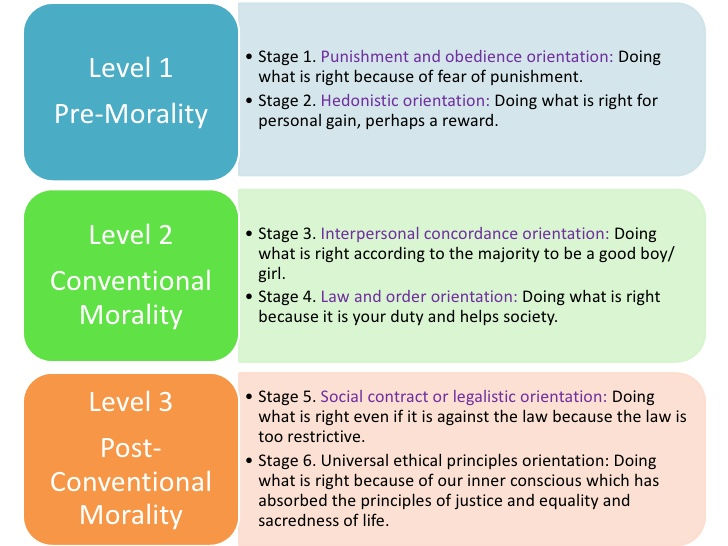
This theory is significant because it defines the framework of how to gauge your moral muscles.
For example, an individual that blasts music and goes over the speed limit without caring for the safety of other drivers on the roads and only follows traffic regulations when a police car is near, is at Level 1 of their moral development. They are control by their self-interest and only act morally because of their fear of punishment.
For Level 2: Conventional Morality, the individual will follow the speed of other drivers on the road, but when no one is around, they will drive carelessly. This level of development is the individual's obligation to follow societal norms.
For a person who is in the Level 3 of their moral development, they have internalized their ethical principles - developed strong moral muscles - they will drive at the speed limit even when the majority of other cars are passing them, because their moral actions dictates that they might endanger others if they go pass the speed limit. Leaders should inspire to be at this level of moral development so that they can make good decisions that are not affected by their own self-interests.
Ethical leaders such as Nelson Mandela, Martin Luther King and Steve Laut the president of CNRL are great examples of individuals who have strong moral muscles. In the case of President Laut, he made an ethical decision to cut top management salaries, including his own, in order to not layoff any of his employees during the recession, while other oil companies had massive layoffs (Krugel, 2015). This made CNRL a desirable place to work for due to committing to their promises. In doing so, their employees reciprocated by working harder and committing more to the company with quality performance and higher levels of productivity. Martin Luther King was a civil rights activists that stood by his strong beliefs of equality to all races and his non-violent protests approach allowed him to effectively accomplished advancement of civil rights that we have today (The Nobel Prize, 2018). Lastly, Nelson Mandela refused to allow himself to be consumed by the hatred of what he had been put through by another race. He insisted on equality for everyone and lived his life by his moral compass, making him one of the great leaders in history (Beresford, 2013).
Below is a great tool that can be apply for confusing ethical cases.
Rushworth Kidder’s 9 steps of Decision-making Format:
1. Recognize that there is a problem
2. Determine the actor
3. Gather the relevant facts
4. Test for right-versus-wrong issues
5. Test for right-versus-right values
6. Apply the ethical standards and perspectives
7. Look for a third way
8. Make the decision
9. Revisit and reflect on the decision
These steps encourage creative solutions and brings insights to ethical decision-making as a learning process.
Implementation
Methods to Develop Your Moral Muscles
Step 1 - Increase your Moral Sensitivity: recognizing the presence of an ethical issue. This is the first step to ethical decision-making because you cannot solve a moral problem without realizing its existent. Pay attention to your emotions when faced with an ethical dilemma. For example, shame, guilt or embarrassment are emotions that encourage us to obey the rules and uphold social order. While anger, contempt or disgust can influence us to make rash decisions. Empathy and perspective skills are key to identifying the moral issue and gaining better moral sensitivity. These skills can be developed through increasing emotional intelligence and moral imagination.
Step 2 - Improve your Moral Imagination: our ability to think outside the box and envision ways to be both ethical and successful. Ways to improve moral imagination is to reflect how your decision can impact others – who and how will you impact them. Challenge yourself by putting yourself in their shoes.
Step 3 - Be aware of your level of Moral Disengagement: this is the process of convincing yourself that ethical standards do not apply to oneself in a particular context. This is done by separating moral reactions from inhumane conduct and disabling self-condemnation. However, if you know your level of moral disengagement, you can reduce these behaviours which will lead to stronger moral muscles and decision-making. First, trace back how your actions may potentially impacted a person. Then go talk to others who are affected or hurt by things to see the effects of other’s actions in order to prevent yourself from committing those behaviours in the future.
Step 4 - Create ways to constantly be Morally Driven: moral motivation can be generated by developing an ethically rewarding environment. Give raises, promotions, public recognition and other means when people act ethically. While reducing the cost of acting morally. This can be done by creating policies and procedures that makes it safer for employees to report unethical behaviours as well as introduce the consequences for unethical behaviour. When faced with a ethical dilemma try tapping into your moral emotions such as sympathy, disgust, guilt, and other emotions can prompt us to take action. Additionally, maintaining a positive outlook and optimism increases a person's moral choices and altruism.
Step 5 - Have decision-making guidelines: consider a systematic approach. This format allows you to carefully define the problem, gather information, apply ethical standards and values, identify and evaluate alternative courses of action, and follow through on your choices. In the process, recognized the influence of your self-interest so it does not control your decision-making.
Step 6 - Practice consistently: moral muscles are built like strengthening your muscles at the gym. Without constant practice, moral muscles will weaken overtime similarly to not attending the gym.
Additional sources to improving your moral muscles are below!
Click here for a better understanding of Moral Imagination!
References
Barboza, D. (2002, June 23). Former Officials Say Enron Hid Gains During Crisis in California. The New York Times. Retrieved from https://www.nytimes.com/2002/06/23/business/former-officials-say-enron-hid-gains-during-crisis-in-california.html
Beresford, D. (2013, December 5). Nelson Mandela obituary. The Guardian. Retrieved from https://www.theguardian.com/world/2013/dec/05/nelson-mandela-obituary
Kahn, J. (2007, July 11). China Quick to Execute Drug Official. The New York Times. Retrieved from https://www.nytimes.com/2007/07/11/business/worldbusiness/11execute.html
Krugel, L. (2015, December 11). Calgary firms avoid layoffs with sabbaticals, shorter weeks and Subway sandwiches. CBC News. Retrieved from https://www.cbc.ca/news/canada/calgary/albert-downturn-avoiding-layoffs-1.3360536
Loudenback, T. (2016, July 11). The story behind the rise of Starbucks' Howard Schultz, who just gave a raise to every US employee of his $82 billion coffee company. Business Insider. Retrieved from
https://www.businessinsider.com/rags-to-riches-howard-schultz-raises-starbucks-wages-2016-7#america-swiftly-took-a-liking-to-starbucks-in-1992-the-company-went-public-on-the-nasdaq-its-165-stores-pulled-in-93-million-in-revenue-that-year-12
The Nobel Prize. (2018). Martin Luther King Jr. Biographical. Retrieved from https://www.nobelprize.org/prizes/peace/1964/king/biographical/


Comments