Cultivating Collaboration
- Eva Luong
- Nov 17, 2018
- 5 min read
Updated: Dec 4, 2018

The Importance of Cultivating Collaboration
Getting people to productively work together towards a common goal is the key function of any organization. It is crucial for leaders to build healthy collaborative environments for their followers in order to improve team dynamic, foster innovation, and increase motivation for effective performance.
Leaders that are successful care more about their team and other teams than themselves. They see that overall success does not depend on the individual, but on the ability for people to work together to get things accomplished at a faster and higher quality rate than what an individual person can manage. When all teams are successful, the firm will be successful. These top leaders recognize the importance of nurturing effective teams, for these team members will carry the leader through in tough situations. Teamwork is the foundation for organizational growth.
Google demonstrates exceptional team building and centres itself on collaboration, making it one of the world's leading tech companies. This is credited to its unique company culture (Forbes Technology Council, 2018). The company has leaders that encourage collaboration, support a sense of community, and build on the free sharing of ideas and expertise (Forbes Technology Council, 2018). This healthy team-oriented workplace generates higher motivation, quality work performance, and visionary innovation that allows Google to be the success it is today.
Theories
Leader-Member Exchange (LMX) Theory
This theory is the idea that a leader develops a closer relationship with one group of followers than with others.
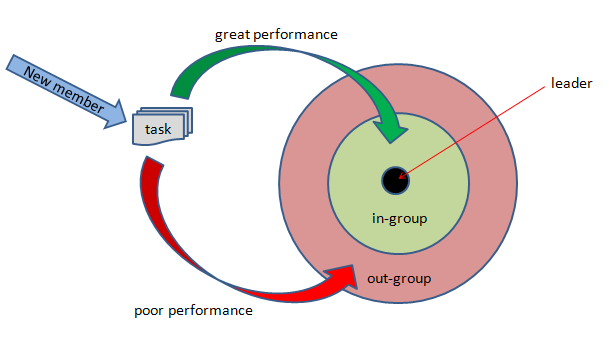
•“In-Group”: Members are favoured by the leader. The leader has high levels of trust for these members, they receive more attention from the leader and they have more access to organizational resources. Both sides mutually influence each other with members more likely to support their leader's decisions. These members function as advisors to their leader and have more personalized exchange with the leader such as being assigned important tasks, participation in the leader’s decisions as well as getting more favourable work schedules. They are highly involved and more open in communication than out-group members.
•“Out-Group”: members in this group are not as favoured by the leader as the in-group. These members are expected to carry out the basic requirements of their job. They are less compatible with the leader, these members will come to work, do their tasks and go home. They don't feel close to their leader and lack motivation for their job because they feel they are being discriminated against by seeing the contrast of treatment from those in the in-group. They are usually not given important responsibilities or given special benefits such as personal support or favourable work hours by the leader.
In this theory, leaders will decide whether a new member will be in the in or out group with respect to their personal characteristics, such as age, gender, or personality. Another way a follower can be granted an in-group status is when the leader believes that individual is competent at their job (MSG, 2018).
The Leader-Follower Relationship
Role-taking: a new member joins the organization, the leader will assess their talent and abilities by assigning or offering them opportunities to demonstrate their capabilities (MSG, 2018).
Role-making: the leader and new member has an informal and unstructured negotiation on work-related factors. The more similarities the member and leader shares, the more likely they will succeed in the negotiation. A betrayal by the member in this stage can result in the member being assigned to the out-group (MSG, 2018).
Good Leaders recognize the development of a privileged group in the workplace and can create solutions to bring all their followers into their in-group. In doing so, this will establish a productive and high performance team environment and thereby, improve the overall efficiency of the organization. One way leaders can achieve this is by forming teams of in and out members and assign in-group members to help improve and develop the out-group members. This will bring out-group members into the in-group and create a collaborative workplace with everyone having high motivation and similar performance levels.
Tuckman's Teamwork Theory

Forming: is the initial stage of team development. Members are finding their place in the team and measuring each other.
Storming: members are starting to see themselves as part of the team. At this stage they will still challenge the leader and other members of the team on how things should be done. This stage has the most conflicts as members clash with each other, which can result in low productivity.
Norming: this stage is where team members will start to settle their differences and come together to work collaboratively by establishing processes, rules and individual's roles in the team.
Performing: this stage is where team members are most productive as they deliver quality performance by understanding each member's strengths to solely focus on the task. Everyone in the team is able to effectively work together.
Leaders can use the stages of team formation to build faster and more effective teams in order to meet company's goals in a more efficient process. Knowing the behaviours of team members in each stage will help the leader to identify the key issues in order to create solutions to bring members closer together for higher work performance (The Happy Manager, 2018).
Implementation

Inspire Innovation: host quarterly team innovation meetings where each member of the team can present their creative idea for the group or clients. Members of the team can then select the winning idea and implement it. This team activity allows members to come together and foster innovation and increase collaboration with other departments in the organization (YEC, 2018).
Keep Individuals Focused: having a strong leader as guidance is key to improving collaboration since these leaders articulate, refine, and internalize a shared vision (YEC, 2018). Without a clear vision it is harder to put together an effective plan for the team to work towards. They also determine the strengths of each member and assign them tasks for each individual to utilize their talents to develop ideas and bring them back to the group with organized meetings and planned agendas for a path forward. Strong leadership holds individuals accountable for effective team performance.
Ask Members to Share Their Story: build empathy and trust through having members in the team individually share their stories (YEC, 2018). This allows the team to understand each person's "why", which is powerful in understanding that person. This reduces misunderstandings and conflicts among the group. This is a great tool to use to welcome new members into the group.
Encourage Open Communication: create a group chat to get the conversation started, because initially people are more comfortable talking in front of a computer than in person. Have team activities that encourage team members to come together to be able to complete their task, and often have meetings for members to engage and discuss their ideas with one another (YEC, 2018).
Align Their Interests: the most effective way to foster collaboration is to align everyone's interests and help members to see the value of each other's work efforts (YEC, 2018). Communication is essential in this process as effective communication allows people to understand the contribution of individual work in the bigger picture. This step is to help members look at things in a different perspective and place themselves in other's shoes. Make clear of the overall goal members will work towards and clarify the deliverables, expectations, and responsibilities for effective teamwork.
An additional resource to build better collaborative teams can be further look into using this site.
Ted Talk
Below are additional resources to better understand the benefits of building collaborative environments:
References
Forbes Technology Council. (2018, February 8). 13 Reasons Google Deserves Its 'Best Company Culture' Award. Forbes. Retrieved from https://www.forbes.com/sites/forbestechcouncil/2018/02/08/13-reasons-google-deserves-its-best-company-culture-award/#6aee3d143482
Mackay, J. (2017, December 22). Research Says These Are the 5 Essential Elements of a Successful Team. Inc. Retrieved from https://www.inc.com/jory-mackay/a-study-of-55-of-worlds-biggest-companies-found-most-collaborative-teams-do-these-5-things.html
MSG. (2018). Leadership-Member Exchange (LMX) Theory. Retrieved from https://managementstudyguide.com/lmx-theory.htm
The Happy Manager. (2018). Teamwork Theory. Retrieved from https://the-happy-manager.com/articles/teamwork-theory/
YEC. (2018, June 14). Six Ways To Improve Team Collaboration And Enhance Productivity. Forbes. Retrieved from https://www.forbes.com/sites/theyec/2018/06/14/six-ways-to-improve-team-collaboration-and-enhance-productivity/#61289aa12037


Comments